Login
May 27, 2026
In rubber and tyre manufacturing, plant reliability is often tested by issues that begin quietly.
A pneumatic valve may need frequent attention. A cylinder may respond slower than expected. Air leakage may increase across utility lines. A tyre-building machine, curing press support system, moulding press, or trimming station may face avoidable interruptions. At times, these problems may also contribute to quality concerns, rejection risk, and higher maintenance pressure.
On the surface, such issues may appear to be machine-level faults. But in many cases, the root cause can be hidden inside the compressed air system.
Moisture, oil, dust, rust, and condensate in compressed air can gradually affect pneumatic systems, air-operated tools, controls, and downstream equipment. For rubber and tyre manufacturers, compressed air quality should not be treated as a utility-room issue alone. In rubber and tyre plants, it directly affects pneumatic reliability, maintenance frequency, equipment life, and production consistency.
The Growing Demands of Rubber & Tyre Manufacturing
Rubber and tyre manufacturing is entering a phase where quality, speed, and reliability are becoming increasingly important. Industrial rubber components are used across machinery, infrastructure, mobility, construction, healthcare, and manufacturing. Tyres, as one of the most significant rubber-based products, serve passenger vehicles, commercial fleets, off-highway vehicles, and electric vehicles.
The scale of the industry makes reliability even more important. The global industrial rubber products market is projected to grow from USD 122.5 billion in 2024 to USD 178.5 billion by 2030. The tyre market is also expected to grow strongly, driven by mobility demand, EV-specific tyres, replacement demand, and premiumisation.
Growth brings opportunity, but it also brings pressure on manufacturing teams. Plants are expected to produce faster, maintain consistent quality, reduce avoidable downtime, and keep machines running with greater reliability. In such an environment, even the utilities working silently in the background begin to matter more.
One such utility is compressed air.
Why Compressed Air Quality Matters in Rubber & Tyre Plants
In a rubber or tyre manufacturing plant, compressed air works behind many everyday operations. It may not be as visible as a mixing mill, extruder, moulding machine, tyre-building line, or curing press, but it supports the systems that help these machines operate smoothly.
Compressed air is commonly used to operate pneumatic valves and cylinders, support gripping and positioning systems, power air-operated tools, assist in cleaning, and enable automated handling across production areas. In rubber product manufacturing, it supports operations such as moulding, trimming, finishing, packaging, and material movement. In tyre manufacturing, it contributes to tyre-building machines, curing press support systems, inspection areas, bead handling, automated handling lines, and utility points.
Because these operations are repeated across shifts, compressed air quality has a direct impact on plant reliability. If the air supply is clean and dry, pneumatic systems respond better, components last longer, and maintenance teams face fewer recurring issues. But when compressed air carries moisture or contaminants, even routine functions can gradually become unreliable.
This is where compressed air moves beyond being just a plant utility. For rubber and tyre manufacturers, it becomes a reliability factor that supports uptime, equipment life, and consistent production.
What Happens When Compressed Air Contains Moisture in Tyre Plants?
In tyre plants, moisture in compressed air can be a hidden risk because many operations depend on repeated pneumatic movement and reliable control. Tyre-building machines, curing press support systems, inspection lines, handling systems, and utility points all require dependable compressed air.
The challenge is that quality issues are not always visible at the compressor room. Air may leave the compressor under pressure, but if it is not treated properly, it can carry water vapour, oil traces, fine dust, rust particles, and condensate through the distribution network. Moisture is usually the most common concern because atmospheric air naturally contains water vapour, and compression increases its concentration.
Once moisture and contaminants travel through the air lines, they can begin affecting tyre plant reliability in different ways:
- Reduced pneumatic reliability: Valves, cylinders, and actuators may require more attention or respond less consistently.
- Higher maintenance frequency: Moisture, rust, oil, and dust can increase wear on downstream components.
- Air leakage and pressure instability: Corroded pipelines, damaged seals, and blocked elements can affect air distribution.
- Curing and handling interruptions: Pneumatic support systems around curing presses and handling lines may face recurring issues.
- Shorter component life: Tools, control elements, and pneumatic accessories may need replacement earlier than expected.
- Increased operating cost: Repeated troubleshooting, spare-part consumption, leakage, and downtime can affect overall plant efficiency.
For high-volume tyre production, even small air-quality issues can become expensive when they repeat across multiple machines and shifts.
Moisture and Contaminants in Rubber Manufacturing Applications
Rubber manufacturing has its own set of compressed air challenges. Whether the plant is producing hoses, gaskets, seals, sheets, moulded parts, or engineered rubber components, compressed air often supports production and finishing activities.
In moulding operations, pneumatic systems may support clamping, movement, control, and part handling. In extrusion areas, compressed air may be used for utility support, tools, and auxiliary equipment. In trimming and finishing, air-operated tools and cleaning operations may depend on consistent air supply. In packaging and material movement, pneumatic devices help maintain production flow.
If compressed air contains moisture or contaminants, the impact may show up as frequent tool issues, inconsistent actuator movement, corrosion inside air lines, or repeated attention from maintenance teams. These problems may not always stop production immediately, but they can reduce confidence in equipment performance.
This is why compressed air treatment should be planned before the issue reaches the production floor. Dryers, filters, moisture separators, and drain systems help remove moisture and contaminants at different stages, reducing the risk of long-term damage across the compressed air network.
Refrigeration Dryer vs Desiccant Dryer for Rubber & Tyre Manufacturing
Not every compressed air point in a rubber or tyre plant needs the same level of dryness. A general utility line, a pneumatic tool, a curing press support system, and a moisture-sensitive control point may have different air-quality requirements.
That is why dryer selection should be based on application need, not only on equipment size.
Refrigeration Dryers
Refrigeration dryers are commonly used for general plant air applications. They remove moisture by cooling compressed air and separating condensed water. In rubber and tyre manufacturing, they are suitable for pneumatic tools, utility lines, moulding support, extrusion support, handling systems, and general automation applications where standard moisture control is required.
Desiccant Dryers
Desiccant dryers, also known as adsorption dryers, are used where extra dry compressed air is required. They are more suitable for critical pneumatic controls, moisture-sensitive equipment, outdoor lines, instrumentation support, or applications where lower dew point air is needed.
Comparison Between Refrigeration Dryer and Desiccant Dryer
| Parameter | Refrigeration Dryer | Desiccant Dryer |
|---|---|---|
| Best suited for | General plant air | Extra dry compressed air |
| Typical use area | Tools, utilities, general pneumatic systems | Critical controls, moisture-sensitive points |
| Drying approach | Cooling and condensation | Adsorption through desiccant |
| Selection basis | Standard moisture removal | Lower dew point requirement |
| Application fit | General rubber and tyre plant operations | Critical or moisture-sensitive operations |
In many plants, refrigeration dryers and desiccant dryers are not competing choices. They serve different compressed air requirements. The right approach depends on flow requirement, dew point need, application criticality, and site conditions.
Compressed Air Dryer Selection Checklist for Rubber & Tyre Plants
A compressed air treatment system is usually planned as a connected flow, where each stage helps condition the air before it reaches plant applications.
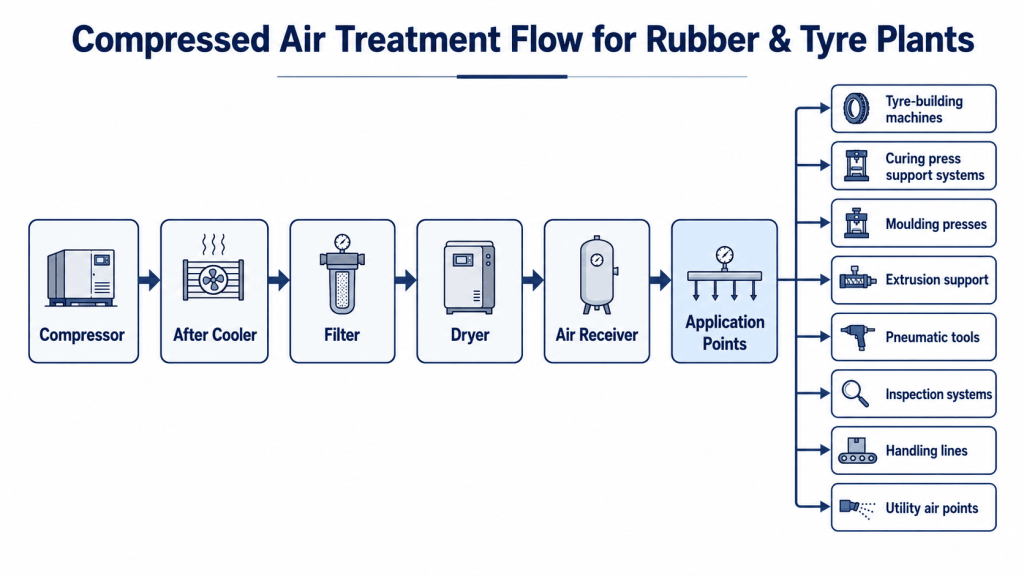
Selecting a compressed air dryer should begin with the actual operating requirement. A dryer that works well for general utility air may not be suitable for a critical control point. Similarly, an oversized or wrongly selected system may add unnecessary cost without solving the real issue.
Plant teams should evaluate a few practical factors before finalizing the dryer:
- Air flow requirement: The dryer capacity should match the plant’s compressed air demand or the demand of the specific application area.
- Dew point requirement: General plant air and critical dry air applications may require different levels of dryness.
- Application criticality: Air used for pneumatic controls, automation, or moisture-sensitive equipment may need more controlled treatment.
- Operating conditions: Ambient temperature, humidity, compressor discharge temperature, and pressure can influence dryer performance.
- Contamination level: If the air contains oil, dust, rust, or particulates, filtration should be planned along with drying.
- Condensate management: Moisture separators, drain systems, and filters should be considered as part of the treatment approach.
- Future expansion: Plants planning capacity expansion should consider whether the selected dryer can support growing air demand.
A clear understanding of these factors helps manufacturers choose between a refrigeration dryer, a desiccant dryer, or a combined air treatment approach. It also ensures that compressed air treatment supports production reliability instead of becoming another maintenance concern.
Where Delair Fits In
Delair helps rubber and tyre manufacturers select the right compressed air treatment approach based on actual plant needs, not guesswork. Depending on the application, Delair offers refrigeration dryers, desiccant dryers, filters, moisture separators, after coolers, air receivers, and auto drain valves to improve air quality before it reaches pneumatic systems, tools, controls, and critical production support equipment.
For general plant air requirements, Delair FDI Series Refrigeration Dryers are based on cooling compressed air to near freezing point to remove moisture and are available in a flow range of 18 m³/hr to 6,000 m³/hr.
For applications requiring extra dry compressed air, Delair DD/DC Series Desiccant Dryers provide ADP up to -40°C to -60°C and maximum up to -70°C, with a range of 3.5 CFM to 1,200 CFM / 6 m³/hr to 2,030 m³/hr.
In addition to dryers, Delair’s filtration and accessory range supports better compressed air quality and condensate management across plant utilities and critical-use points. This gives manufacturers a practical way to strengthen compressed air reliability without treating every application with the same air-quality approach.
Conclusion
For rubber and tyre manufacturers, compressed air quality is closely linked with plant reliability. Moisture and contaminants may not always be visible, but they can affect pneumatic systems, maintenance frequency, equipment life, and production continuity over time.
A properly selected combination of compressed air dryers, filters, and accessories helps reduce these risks before they reach critical plant applications. As production environments become more quality-driven and uptime-sensitive, compressed air treatment should be viewed as a practical reliability measure, not just a utility-room requirement.
For plant managers and maintenance teams, the objective is not only to dry compressed air, but to reduce hidden utility risks before they affect production.
Facing moisture, leakage, or repeated pneumatic failures? Connect with Delair to evaluate the right compressed air treatment solution.
Email: [email protected] / [email protected]
Frequently Asked Questions
1. Why is compressed air important in rubber and tyre manufacturing?
Compressed air supports pneumatic tools, valves, cylinders, automation systems, handling lines, curing press support systems, moulding machines, and utility operations. It helps several production and support systems function reliably.
2. What happens when compressed air contains moisture in tyre plants?
Moisture in compressed air can contribute to corrosion, air leakage, valve malfunction, slower cylinder response, pressure instability, and recurring maintenance issues. In tyre plants, this can affect pneumatic systems used around tyre-building machines, curing press support systems, handling lines, and inspection areas.
3. Which dryer is suitable for rubber and tyre plants?
A refrigeration dryer is generally suitable for plant air applications where standard moisture removal is required. A desiccant dryer is suitable when extra dry compressed air or lower dew point air is required.
4. What is the difference between a refrigeration dryer and a desiccant dryer?
A refrigeration dryer removes moisture by cooling compressed air and separating condensed water. A desiccant dryer removes moisture through adsorption and is used where extra dry air or lower dew point performance is required.
5. Are filters required along with compressed air dryers?
Yes. Dryers mainly remove moisture, while filters help remove dust, oil, rust, and other contaminants. For better compressed air quality, compressed air dryers and filters are often used together.
6. How can rubber and tyre plants select the right compressed air dryer?
Rubber and tyre plants should evaluate air flow requirement, dew point requirement, application criticality, operating conditions, contamination level, condensate management, and future expansion before selecting a dryer.