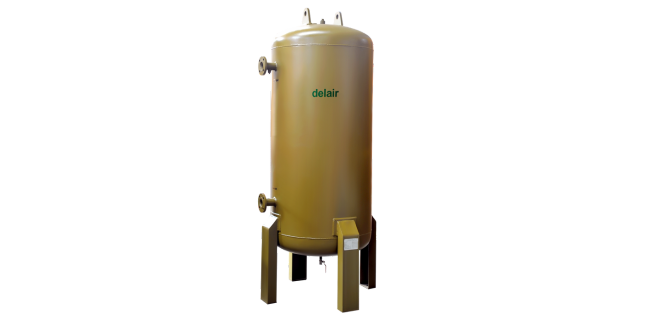
Air Receiver – VAR Series
Air Receiver without hole
Range0.5 m3 to 15.0 m3
Our Airgineers Can Help You Select The Right Product!
Enquire Now
Frequently Asked Questions
An air receiver stores compressed air and supplies it when the compressor is not running, so downstream equipment gets a steady air supply. It also acts as a pulsation damper, smoothing pressure surges from the compressor, and as a moisture trap, allowing condensate to settle and drain before the air moves downstream.
The air receiver is available in 11 standard models with capacities ranging from 0.5 m³ to 15.0 m³. Its standard working pressure is 7.0 kg/cm²(g), with a working temperature of up to 60°C. Higher capacities can be provided on request.
An industrial air receiver should be built to a recognised design code and tested before despatch, so it can safely hold compressed air at working pressure. Standard instrumentation usually includes a pressure gauge to monitor stored pressure, a safety relief valve to protect against overpressure, and a drain to remove accumulated condensate from the bottom of the vessel.
Delair offers air receivers in 11 standard models with capacities from 0.5 m³ to 15.0 m³, in a compact design and constructed to international design codes, with each unit pneumatically and hydrostatically tested. An auto drain valve and construction to other applicable codes are available as options, and higher capacities or other working conditions can be provided on request.
Delair air receivers have a standard working pressure of 7.0 kg/cm²(g) — about 6.9 bar (~100 psi) — and handle temperatures up to 60 °C. Every unit is built to international design codes such as ASME and IS-2825, and is pneumatically and hydrostatically tested. Other working conditions are available on request.
As a rule of thumb, match receiver volume to your compressor’s free air delivery and demand pattern — larger tanks suit intermittent or variable loads and reduce compressor cycling. Delair offers 11 standard models from 0.5 to 15.0 m³; confirm exact sizing against your CFM, duty cycle, and allowable pressure drop with Delair. Higher capacities are available upon request.